

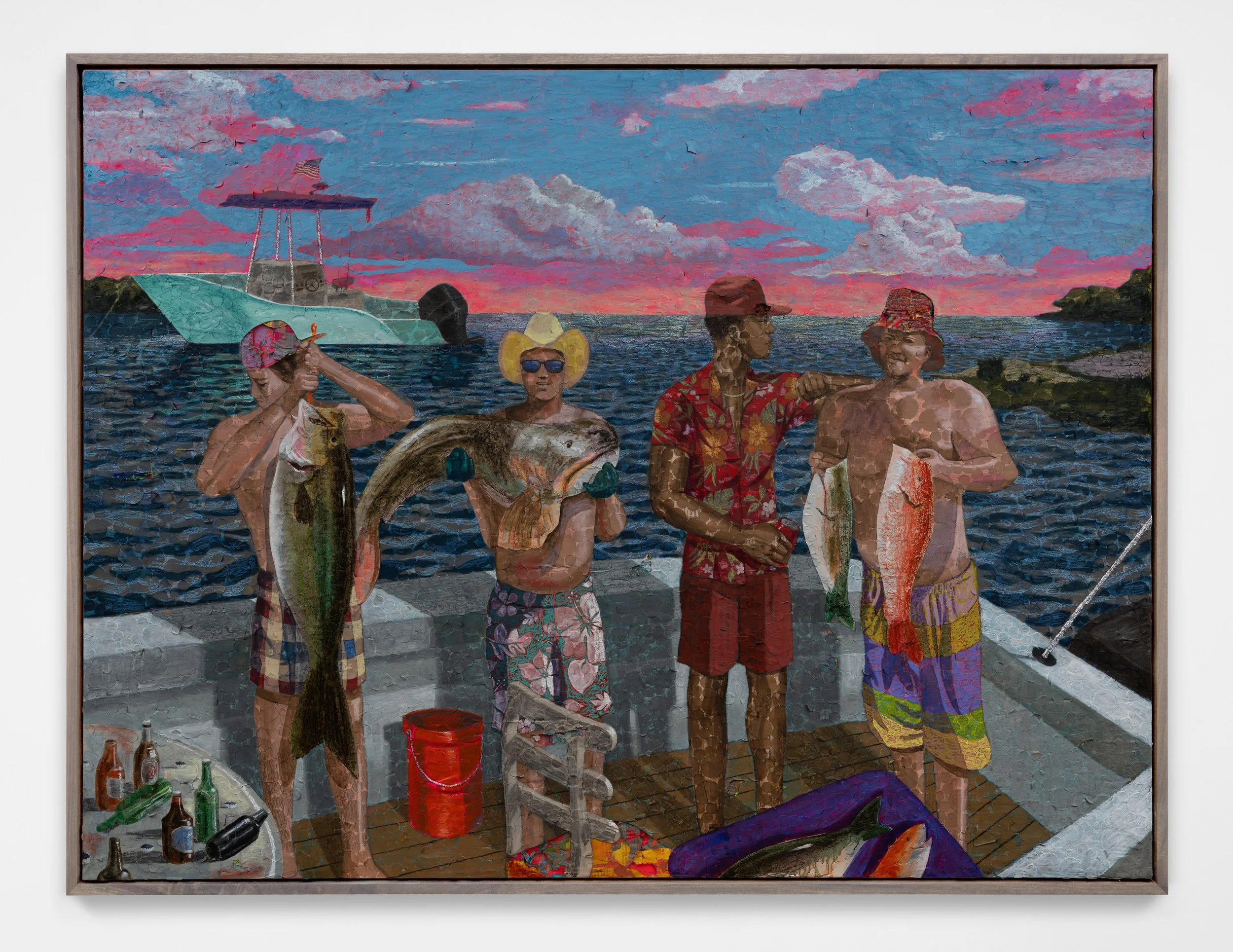
Derek Fordjour, Fishing Trip, 2026. Courtesy the Artist. Photography by Daniel Greer
Spotlight: Derek Fordjour
NOVEMBER 11-DECEMBER 18, 2026
The FLAG Art Foundation’s Spotlight exhibition series includes new or never-before-exhibited artworks accompanied by commissioned pieces of writing. It is the hope of this series to create focused and thoughtful dialogues between the visual arts and authors, critics, poets, peers, scholars, and beyond. In this iteration, the Spotlight features a new work by Derek Fordjour and a text by journalist and author Donovan X. Ramsey.
In The Dark, Surrounded
By Donovan X. Ramsey
We are practiced at imagining the danger young Black men pose. We struggle to imagine the danger they are often in.
One night in my twenties, I crossed a Harlem street just to spare a woman the thought of me, and found myself alone with a danger I had forgotten to consider.
I was in graduate school then, walking home at hours when the sidewalks emptied and footsteps acquired a sudden, heavy significance. I had been big and Black long enough to learn the necessary accommodations: Give people room. Watch your pace. Know exactly where your shadow falls.
The woman ahead of me was young, dressed for the evening. I was walking fast. I knew the silhouette I cast, so I stepped into the street.
Then the thought caught me from behind: Of everyone out here, you are the most likely to be killed.
I couldn’t have known the fates of everyone on that block, but I knew the math. As a criminal justice reporter, I had trafficked in the statistics of young Black men. I had written the numbers. I believed I understood them.
Now, the math was all around me. It was in the few drinks I'd already had. In the police car that passed. In the dark alleys. In the bodies of the strangers scattered here and there. In the shadows and footsteps behind me.
Did anyone know where I was? If I didn’t make it home, who would notice? How long before someone came looking? What would they imagine when they found me?
The woman had done nothing. I had the grace to cross the asphalt. I didn’t resent the courtesy. What broke me, however, standing there, was the chilling ease with which I had considered her safety while utterly forgetting my own. I could be broken, too. I was out in the world. In the dark, surrounded.
I have carried that night with me while watching the darkness gather around Nolan Wells.
Nolan was eighteen. He went to Mississippi’s Horn Island to celebrate the Fourth of July and never came back. When the water gave up his body two days later, the authorities classified it "undetermined." A grand jury whispered drowning. His family screamed for the truth.
They look at the evidence and see a void. Why would a boy voluntarily stay on an island without his phone, while the boat that brought him drifted back to the mainland? They point to the unexplained bruising on the back of his head. They point to the autopsy’s empty airways and empty stomach—strange anatomy for a drowning.
The stories fracture. Friends claimed he stayed for a girl; that girl said he was heading back to the boat. This fracture is everything. The assertion that he chose to stay has become the flimsy scaffolding holding up everyone else’s alibi for leaving him.
The family’s independent pathologist sees the same gaping holes: Was Nolan even conscious when he met the water? Was the entry a choice or a surrender? These aren't just doubts; they are wounds in the official narrative.
His mother, Christine, sits with these broken stories and demands a reckoning. The family wants a federal investigation. I am with them. The neat bureaucratic box of a drowning cannot tell me what threw an eighteen-year-old boy into the deep, or what held him there. It does not explain the bruises. It does not bridge the silent, damning hours between the last time he was seen alive and the moment someone finally realized he was missing.
I cannot tell you his final thoughts. I cannot know if there was time for terror. But I know this: he was in peril. Long before the medical examiners and the grand juries drafted their sterile language, there was a point in the dark where a boy was alive, and then a point where he was fighting to stay that way.
Put yourself in that water, alone, surrounded. Darkness above you and beneath you, so complete you cannot tell where the water ends and the sky begins. The shore is somewhere beyond your reach. Imagine cold water seeping through your clothes, wet cloth clinging to your chest, your sleeves dragging against your arms as you try to lift yourself another inch.
If you are alive, feel the effort of keeping your mouth above the surface, of drawing a breath before the next mouthful of salt. From the island, imagine the thin, distant chorus of insects and frogs, the sounds of solid ground. Your ears go under and the chorus disappears. You come up gasping. Try to call out while trying to breathe. And if you are already dead, consider your body dragged by water you can no longer struggle against, the cold envelopes you without you feeling it, your body passing above and below the surface.
Who knew where he was? Who expected him on the boat? Who noticed that his phone had returned without him? Who thought to ask whether he was safe?
I look for that person in the accounts of his last hours. I cannot find one.
That absence does not establish that someone killed him. It does not establish that many people knew he was in danger and left him to die. It leaves me unable to dismiss either possibility.
We possess a rich, exhaustive vocabulary for the danger a young Black man supposedly poses. We map the span of his shoulders, the slump of his hood, the quickness of his hands. We alchemize these details into a mandate for our own vigilance. But his vulnerability? We are blind to it, even when it washes up at our feet.
The insistence that Nolan chose the island is asked to carry an impossible weight. It becomes the absolution for every person who boarded that boat and left him in the dark. It is their release.
I refuse it.
It was not reasonable to assume he was safe. It was not reasonable to leave him behind. It was not reasonable to take his phone back to the mainland without him. To accept these decisions as reasonable is to accept that he could come to no harm, or that the possibility of harm did not require anyone to act.
Now he is dead. The question of what happened to him remains.
That night in Harlem, I knew to consider a woman’s fear before I considered my own safety. I had learned the obligation so thoroughly that I stepped into the street without thinking. Only then did I remember that I could be hurt.
I still wanted her to get home unharmed. I want someone to want that for me. I wish someone had wanted that for Nolan.
There is nothing extraordinary in that expectation. A young Black man should not have to be harmless to deserve protection. He should not have to be helpless before anyone thinks to offer it. His strength does not relieve the people around him of concern. His death does not relieve them of an explanation.
The tragedy isn't just that Nolan Wells died in the dark, but the unbearable ease with which he is still being left there.
About:
Derek Fordjour (b. 1974, Memphis, TN, to Ghanaian parents) is an artist living and working in New York, NY. Fordjour is the recipient of the 2025 Gordon Parks Foundation Artist Fellowship, the 2023 St. Jude Children’s Research Hospital Spirit of the Dream Award, and the 2022 Alliance for Young Artists & Writers Alumni Achievement Award. He has previously served as the Alex Katz Chair in Painting at The Cooper Union for the Advancement of Science and Art, New York, NY, and a Visiting Critic at Yale University, New Haven, CT, and Columbia University, New York, NY. Fordjour has received public commissions for High Line Art, New York, NY, and MTA’s Arts & Design program New York, NY, and MOCA Grand Avenue, Los Angeles, CA. Fordjour’s work is held in notable public collections including the Metropolitan Museum of Art, New York, NY; Whitney Museum of American Art, New York, NY; Guggenheim Museum, New York, NY; and The Royal Collection in London, United Kingdom, among others. His work has been reviewed in numerous publications including The New York Times, The Los Angeles Times, The Wall Street Journal, and The Financial Times. A monograph of his work is forthcoming by Phaidon in 2027. He is a graduate of Morehouse College in Atlanta, GA, earned a Master’s Degree in Art Education from Harvard University, Cambridge, MA, and an MFA in painting from Hunter College, New York, NY. In 2021, he founded Contemporary Arts Memphis, a youth-based arts organization in his hometown.
Donovan X. Ramsey (b. 1987, Columbus, OH) is an indispensable voice on issues of identity, culture, and power in America. His reporting has appeared in The New York Times, The Atlantic, GQ, WSJ. Magazine, Ebony, Essence, and other outlets. He has worked as a staff reporter at the Los Angeles Times, NewsOne, and theGrio, and as an editor at The Marshall Project and Complex. Ramsey is the author of When Crack Was King: A People’s History of a Misunderstood Era, a work of narrative nonfiction about how Black America survived the crack epidemic, published by One World, an imprint of Random House. He holds degrees from the Columbia University Graduate School of Journalism, New York, NY, and Morehouse College, Atlanta, GA.
Katy Siegel is a Distinguished Professor and the Thaw Chair at Stony Brook University, Stony Brook, NY. Her curated exhibitions include Joan Mitchell; Odyssey: Jack Whitten Sculpture, 1963-2017; Mark Bradford’s pavilion at the Venice Biennale; Generations: A History of Black Abstract Art; and Postwar: Art Between the Pacific and the Atlantic, 1945-1965. She has written and edited several books, including the Joan Mitchell catalog; Jack Whitten: Notes from the Woodshed; and out this fall from Yale University Press, What Was America? Art, Culture, and Politics in 1976.